

The Number of House Republicans Seeking Another Office Could Mean Math Problems for Leadership
An already unproductive Congress could get even worse

There’s a little more than a week left in the First Session of the 119th Congress. The year hasn’t been terribly productive for either chamber. Granted, that may depend on one’s perspective. Through December 8, only 47 pieces of legislation have been signed into law.1 In perspective, 274 pieces of legislation were signed into law during the 118th Congress, which was one of the least productive since at least the 82nd Congress.2
Congress has had challenges in 2025, to say the least. The most notable being the record-long 43-day government shutdown that stretched from October 1 through November 12. The House, of course, infamously left town before the government shutdown, taking its last votes on September 19 and not returning until November 12 to vote to end the shutdown.
Before the 119th Congress, House Majority Leader Steve Scalise (R-LA) released a calendar showing the number of days the chamber would be in session. That calendar was revised in July to reflect a total of 122 legislative days. By my count, the House has been in session and voting for only 97 days. Including this week’s votes, there are only eight more legislative session days left in the year.
The 2026 calendar has been released, and it shows 115 legislative days. This is stereotypical for an election year. You have to wonder, though, if the House will actually be in session for that many days. As of January 5, when Rep. Marjorie Taylor Greene (R-GA) resigns, the House will have 433 voting members—219 Republicans and 214 Democrats. The threshold for passage for a partisan bill 217 under those circumstances, assuming every member is present and voting. It’s likely that the seats left vacant by Greene and former Rep. Mikie Sherrill (D-NJ) will be filled by mid-April.3 In other words, Republicans can’t lose more than three votes to advance any partisan legislation.
Where the numbers game gets interesting is the Republicans who are running for higher office. By my count, 18 House Republicans are seeking another office. The primaries for those races range from early March to mid-August. Now, not everyone who is seeking another office faces a competitive primary. Most arguably do. There are also multiple members seeking another office in the same state. Some are running in primaries for the same office. That’s where things get tricky.
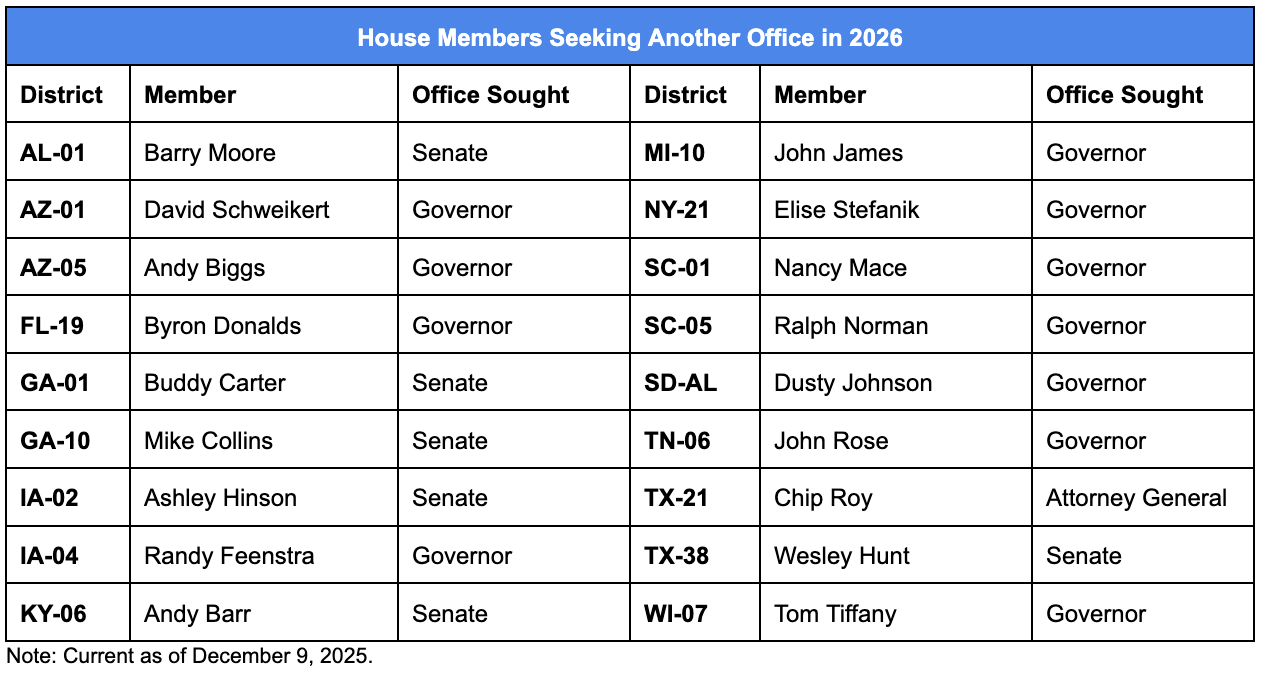
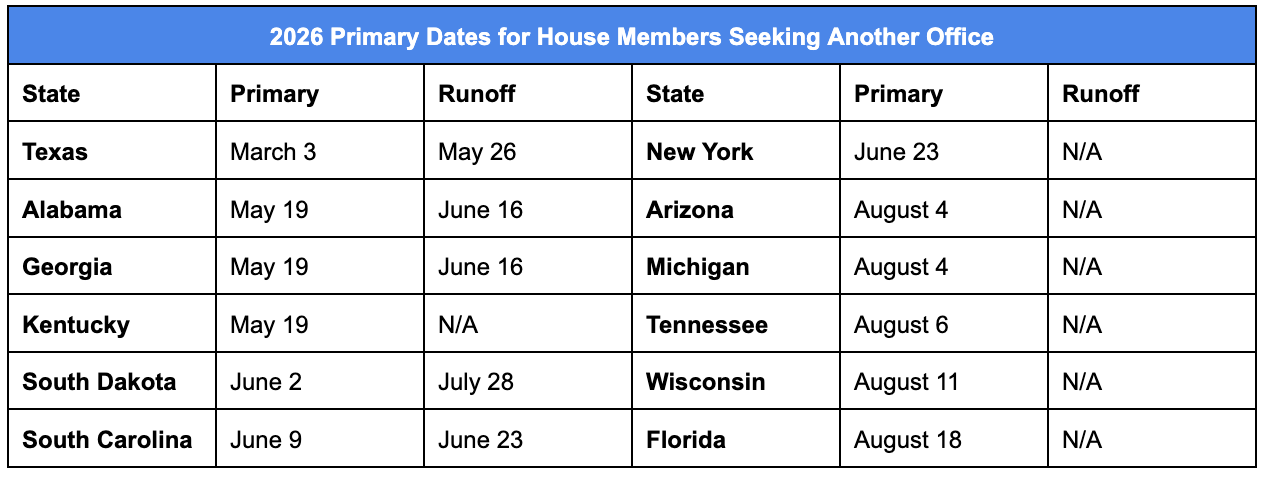
With the exception of the August primary dates, which occur during the standard recess for the month, every other member seeking office has a primary date that conflicts with the current House calendar for 2026. There are often absences during votes. Sometimes, a member has commitments that they have to attend to that force him or her to miss a vote. Other times, it’s an illness. In the 116th Congress, the median of missed votes was 2 percent. Members miss votes while campaigning for another office, and that means even more missed votes.
Now, I’m sure House Republican leadership will push for maximum attendance. However, necessary procedural steps could be hampered if there are absences. For example, Speaker Mike Johnson (R-LA) has overseen at least seven rules providing for the consideration of partisan legislation fail on the floor.4 That’s a record for any Speaker. This is, in part, because of tight party divisions in the House.5 Not only does Johnson have to worry about members breaking on a procedural vote, but absences can also affect outcomes. There’s also the possibility of random resignations or prolonged illnesses that could keep members from voting.6
Maybe nothing comes from these extraordinary circumstances. I don’t know. The week of May 18,7 with the House currently scheduled to be in session, four House Republicans have primaries on May 19—each of them locked in competitive primaries. This could give House Democrats an opportunity for shenanigans, assuming they don’t have attendance issues of their own. Regardless, an already unproductive Congress so bitterly divided may become even more unproductive in an election year.
This doesn’t include legislation that has been presented but not yet signed. Assuming all pending bills are signed, the number is 55. This number includes only House and Senate bills and joint resolutions.
The 82nd Congress ran from January 3, 1951 to January 3, 1953.
Sherrill resigned on November 20. She was elected Governor of New Jersey last month. The special election to fill the seat left vacate is April 16, 2026. The special election for the seat left vacant by Greene’s resignation hasn’t been announced.
The linked article mentions five at the time of its publication in February 2024. There was another one in April 2024 and one earlier this year. That brings the total to seven. I say “at least seven” because it’s possible I’m missing something.
Part of me is sympathetic to Johnson because of the tight party lines. It’s not always his fault when he loses a procedural vote. That said, I will continue to insist that Johnson was and still is too inexperienced for the role he has. His success has always come when Trump has a stake in what the House is doing. There’s so much frustration with Johnson from his conference. As long as Trump backs Johnson, he’ll remain Speaker, though. What’ll be interesting is where Johnson lands if Republicans lose the House in 2026. The usual assumption is that a Speaker takes a step down to Minority Leader in those circumstances. I don’t know that there’s a place for Johnson there.
That’s an issue for both parties.
One can reasonably argue that the votes the week or two prior could be affected as well. The only break under the current schedule is the week of April 27. Obviously, weekends don’t count. That limits the ability of members running for another office to campaign.